connoisseur of all things gifted

Pining for Pinterest

 Do you know this symbol? 

If so, you may have found that you no longer have time to actually do  anything because you’re too busy pinning things you want to do.

As you may know, we have a Pinterest site where parents, teachers, or other interested parties can find ideas na links to items of interest to bright kids (and their staff).   It looks like this:


You must be a member of Pinterest (free, but requires an invitation – send me an email privately at lisa at vangemerts.com if you’d like one) to follow the boards, but anyone can see the items – no registration required.

The different boards are:

Mad about Math

Resource Potpourri

World Wonders

Loving Literature

Blinding Me with Science

Schoolroom Ideas

A newly-added board is “The Sharing Place”. This is so others can share items they think would be of interest. To be a contributer to this board, you must have two things: a Pinterest board that has some applicability to education or parenting, and you must send me your name so that I can add you as a contributor. I’d love to see some of what you’d love to share!

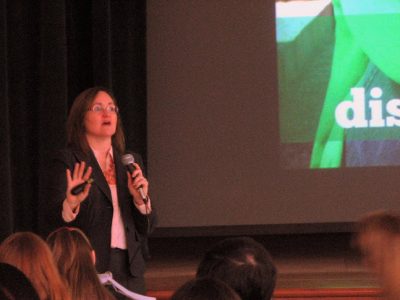
So, I just got back from the Georgia Gifted and Talented conference, and I’m heading out to another one in Austin, and in between I’m facilitating a lot of professional development for teachers. Having this sandwich of experience has led me to write about five things I think that teachers at professional development can learn from teachers at conferences. 

1) Even if you’re there because someone else wants you to be, you can still get a lot out of it.

 One thing I notice at conferences is that the teachers are just sucking the marrow out of it.  They’re going on very little sleep, their spouses are texting weird questions like, “So, how do you get vomit out of the carpet,” and they’re worried about what the sub is doing to the classroom in their absence, but still….they’re focused.  They’re going through the program offerings like a J. Crew catalog.  The pages are folded over.  Choices are starred, and then crossed out, and then starred again.  They argue the merits of speakers and sessions.  They divide and conquer, determined to share, but knowing that nothing beats being there. 

Contrast this with what we sometimes see at “normal” professional development.  Some teachers don’t engage.  Some resent it. Some don’t focus on what’s going on because they’re too focused on what they’d rather be doing.  Some stay in the shallow waters of thought, surreptitiously checking Facebook and texting, rather than diving in to what is there to be found.

 Take-away: You can be forced to go, but you can’t be forced to hate it.  It’s only a waste of time if you make it one.


2) Go to what you need, not just what you like. 

Teachers at conferences have to choose between sessions that they WANT to attend, and sessions they SHOULD attend.  Frequently, you will overhear teachers say, “I wanted to go to that one, but I really need to learn how to do this.”  Just because something a teacher went to “counted” for continuing education credit doesn’t mean that it was what was really needed by that teacher.

Take-away: Instead of taking the easy way out and doing PD that is comfortable, stretch a little.  Choose opportunities that will expand your professional skills and knowledge base.

3) Be a Tinker Toy. Connect.

One of the most valuable things any teacher can get from a conference is connection with other teachers.  People are anxiously scribbling email addresses on the backs of handouts and typing numbers into phones.  Almost always, the most important thing I take away from a conference is personal connection.

Even for a district-led professional development opportunity, get business cards made and share.  Create a Linked-In profile.  Get on Twitter.  Find a way to connect with other teachers beyond the PD session. 

Take-away: Leave professional development with personal connections, not just handouts.

4)    Be a meta-educator.  Don’t get stuck in your content area.

At conferences, teachers attend sessions with little or no regard for content area as a restriction.  Teachers in all domains are in virtually every session because truly excellent teachers understand that sometimes you learn the most from people outside of your world. 

Developing the ability to see the application and possibilities for our own classrooms in any session is the key to truly advanced professionalism, and this is true in any field.  We will rarely have “drag-and-drop” experiences where we can take something and put it directly to use in the classroom with no modification.  That doesn’t mean it’s not valuable.

Take-away: Broaden your horizons about what you can learn from whom.


5)   Cast your bread upon the waters.

 When teachers come home from conferences, they’ve got bags brimming with handouts and information.  They’ve got spirals full of notes (most of which they understand) or electronic devices with far less memory space available.  And they want to tell you about it.  They want to share the cool session they went to, the neat thing they learned, the resource they’re dying to try.

This same thing is possible with more mundane professional development.  Make a point to get together with colleagues afterwards to share applications and ideas. You may find that what you thought was a desert-like session with virtually nothing to offer actually had a shimmering oasis you can use or develop.

Start a blog.  Tweet it out.  Send an email.  Share.

Take-away: Don’t be the place ideas go to die.  Share with other teachers what you’ve learned in the way that’s most comfortable for you.

To put my money where my mouth is, I’ll be sharing ideas on this site and at Pinterest.com/brightkids.  Also, find my presentations and handouts from the conference here.

Georgia on My Mind

I am at the Georgia Association for Gifted Education conference in Callaway Gardens, GA (code for gorgeous), and I am taking away some great ideas.  New tip: if you ever get the opportunity to hear Brian Housand speak, take it!  In the interim, check out his website and find great ideas.

Here are the prezis from my presentations.  First, Differentiation Made Easy: Low-Prep Potpourri.

Welcome to Ten Days of Stealth Giftedness: A Crash Course on Incognito Intelligence

This is your guide to effectively hiding your giftedness from the world.

Kind of like being the James Bond or Jason Bourne of smart.  Or both.

Like these boys.

Day 10: Pack up your adjectives.

A long time ago, in a galaxy far, far away there was a program called “Schoolhouse Rock.”  This program taught cool stuff like how a bill becomes law and the purpose of conjunctions through fun songs.

One song was called “Unpack your Adjectives.”

(image courtesy of http://www.thedeeparchives.com/images/products/ssexbshr349_sml.jpg)

One line of this song says, “Adjectives are often used to help us compare things.”

One of the things adjectives compare is people.

Some people are tall, and some people are short.

Some people have brown hair, and some people have blonde hair.

Some people learn like other people, and other people…

Well, other people learn very, very differently.

They learn more quickly and sometimes more deeply than others.

We call this gifted.

And when you unpack your adjectives, there are words that people associate with people who learn like that.

In a study done by Kevin O’Connor at the University of Connecticut, he found that the adjectives listed below were associated with gifted individuals:

intelligent (duh)

ambitious

clever

alert

capable

opinionated

argumentative

arrogant

boastful

impatient

bossy

Now, if you’re like me (and you probably are or you wouldn’t be reading this), you were good up until “arrogant.”  I mean, “opinionated” and “argumentative” aren’t fabulous descriptions, no one need covet them, but “arrogant” ?

Well, “arrogant” is just going too far.  And as for “bossy.”

Well, I’m not bossy, I just have better ideas.

So the last piece of advice I have for those of you striving to disguise your gifted nature is to pack up these adjectives.  Avoid acting intelligent or alert or capable at all costs.  Good luck with that.

Let’s look at the opposites, shall we?

Rather than the list above, strive to unpack these adjectives:

unintelligent

apathetic

slow

disinterested

helpless

neutral

complacent

timid

self-deprecating

patient

pushover

Now, what you may find after this crash course on stealth giftedness is that it’s just not worth it.

Sometimes, as hard as it is to be gifted, it’s even harder to pretend to be something else – disinterestedness and complacency don’t come easily to the quick of mind.

So feel free to reject all of this advice and unpack the adjectives that describe who you really are, even if they are not right now what you wish people would use to describe you.

Arrogant?  Ridiculous.

In honor of Read Across America Day March 2, I have recorded a presentation of The Velveteen Rabbit.  I hope you and all the readers in your home will enjoy it.


Stealth Giftedness: Day 9

Welcome to Ten Days of Stealth Giftedness: A Crash Course on Incognito Intelligence

This is your guide to effectively hiding your giftedness from the world.

Kind of like being the James Bond or Jason Bourne of smart.  Or both.

Like these boys.

Day 9: Play it again, Sam.

Gifted kids get stuff quickly.  In fact, frequently they get it as soon as the teacher starts to speak.  Their brains just leapfrog fifteen steps ahead, and there they are. Like this frog.  Doesn’t this frog look gifted?

So, in order to hide your giftedness, you are going to have to abandon your inner mental leapfrogging and change verbs to “plodding.”  Practice these phrases until they come out naturally and fluently.

“I don’t get it.”

“Can you repeat that?”

“You’re going too fast.”

“Wait. What?”

“I’ll never understand this.”

“Can you say that a little more slowly?”

You will need some facial expressions and gestures to add legitimacy to these phrases.

Head scratching.

Scrunchy eyes.

Crinkly nose.

Slight head tilt.

You want to look like you just ate something a little off, perhaps a day or two out of date.

This guy has it down.

Add a few loud sighs of frustration (shouldn’t be a problem), and you’re set.

No one will guess you’re gifted.  Your secret is safe.


Stealth Giftedness: Day 8


Welcome to Ten Days of Stealth Giftedness: A Crash Course on Incognito Intelligence

This is your guide to effectively hiding your giftedness from the world.

Kind of like being the James Bond or Jason Bourne of smart.  Or both.

Like these boys.

Day 8: Grade A. Not.

If there is anything that is a dead giveaway for a gifted kid, it’s good grades.  Now, those of us in the know understand that good grades aren’t necessarily the sign of giftedness.  You can be highly gifted and still fail miserably at school.  It’s probably considerably more miserable for your teachers and parents, but you get the idea.  You can also very easily have a hard working teacher pleaser get much better grades than an apathetic gifted kid.

But it is also true that if you consistently get good grades, people will begin to wonder about you.  “Is she gifted?” And so the rumor mill begins to churn. If you want to make sure that no one figures out that you’re gifted, you’re going to have to abandon your task commitment and embrace your inner “B” student like this Storm Trooper has done.

You can do it with these two simple steps:

First, you have to learn to shrug.  The nonchalance of a shrug (just a simple right shoulder lift will do) conveys that the 82% you are seeing on your math test grade means nothing to you.  Even though we both know you are a churning cauldron of fiasco inside.  The shrug will be your cover.  Practice this move:

Next, you need to learn to stop asking for extra credit when you earn a 98 on something. That’s a dead giveaway.  Don’t ask for extra credit at all.  Remain silent while others plead for a curve.

Remember – caring about grades will out you every time.

Stealth Giftedness: Day 7

Welcome to Ten Days of Stealth Giftedness: A Crash Course on Incognito Intelligence

This is your guide to effectively hiding your giftedness from the world.

Kind of like being the James Bond or Jason Bourne of smart.  Or both.

Like these boys.

Day 7: Look sickly at your peril.

To paraphrase Jane Austen, it is a truth universally acknowledged, that a person in possession of a good intellect must be in want of health and robustness.  The stereotypical gifted individual is pasty and sickly, like someone who has endured a particularly dismal London winter.

In order to hide one’s giftedness, therefore, it is required that one appear as if one is apt to climb an Alp at a moment’s notice with robustness.  Typical health is not sufficient disguise.  One must go overboard.

Substitute your sneakers for hiking boots (extra stealth points for having them covered in mud).

This:

Not this:

Muss up your hair a little bit to look windblown.

Throw random references to physical health into brief pauses in conversation.

Leave a gym membership card dangling on your keyring.  Optional: actually owning a gym membership card.

Girls, wear your hair in a messy ponytail in manner of person just returned from run with no time for new blow-dry.

Drink electrolyte-filled beverages.  Ignore the fact that they have more sugar than Kool-aid.

In this way, if someone accuses you of being gifted, those around you will jump to your defense saying, “Oh, no, she can’t be gifted.  She’s far too healthy for that.”

If, heaven forbid, you actually GET sick, hide. It will takes months to undo the damage.

Stealth Giftedness: Day 6

Welcome to Ten Days of Stealth Giftedness: A Crash Course on Incognito Intelligence

This is your guide to effectively hiding your giftedness from the world.

Kind of like being the James Bond or Jason Bourne of smart.  Or both.

Like these boys.

Day 6: Curb Your Enthusiasm.

The stereotype of the gifted kid as being an over-eager teacher’s pet prevails, and so to be stealthy about your giftedness you must pretend as if you do not care one whit about school, your teacher, your future, your grades, or anything else that might be construed as investment in school.

In other words, look bored.

Of course, it’s possible that  you actually don’t care one whit about any of this, in which case today’s assignment should be a piece of cake.

While you are being a member of the Stealth Gifted cadre, there will be no clapping of erasers, no elation over a good grade, no public displays of motivation, and no hint of emotional investment in your education.

In other words, if your teacher needs a pet, he’s going to have to get a dog.

But if he brings the dog to school, you can’t act interested.

Stealth Giftedness: Day 5

Welcome to Ten Days of Stealth Giftedness: A Crash Course on Incognito Intelligence

This is your guide to effectively hiding your giftedness from the world.

Kind of like being the James Bond or Jason Bourne of smart.  Or both.

Like these boys.

Day 5:  Avoid the use of behemothic words.

One of the hallmark traits of gifted individuals is not autohagiography as many believe.  Rather, it is the use of advanced language unassumingly.

Gifted kids use big words not to show off, but because those are the best words for the situation.

Many bletcherous textbooks are written without this in mind, and so the gifted child, reading them, may become prone to cachinnation.

The only defense against the pathetic nature of most of the language one encounters is the cacoethes to use awesomely humongous words because they are the perfect fit for the situation. Being forced to use teeny words just so people don’t discover your true identity is the wanweird of the stealth gifted.

So, there will be no lovely verbage, my friend.

No more trolling through the dictionary to soak up the beauty of your native tongue. No more sweetness of just the right word tripping off the tongue like a child with a jump rope… Indeed, you must use pedestrian language at all times, lest you are accused of using big words to “sound” smart (which begs the question, “What should a smart child sound like?”).  So, think about using words with no more than three syllables (and use those sparingly).  Short. Common. Boring.  Indistinct. Non-specific. Welcome to their word, young Padowan.  Just take care not to try this experiment too long, or you will get the mulligrubs.

autohagiography – speaking or writing in a smug fashion about one’s life/accomplishments

bletcherous – pertaining to something poorly or disgustingly designed

cachinnation – loud or hysterical laughter

cacoethes – bad habit or insatiable urge

wanweird – unhappy fate

mulligrubs – state of depression or low spirits